
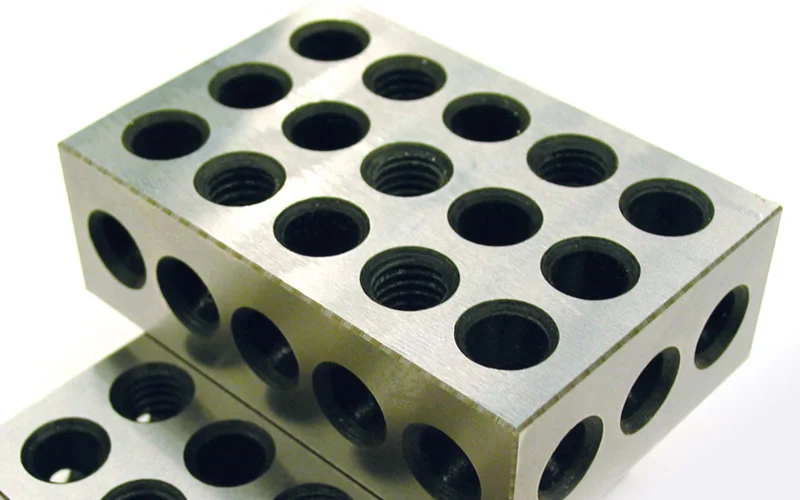
Short answer: A 123 block is a hardened, precision-ground steel setup block measuring 1" thick × 2" wide × 3" long. Machinists use 123 blocks in matched pairs to raise a workpiece to a known height, support it in parallel, square it to a table or vise, and serve as a reference when measuring or checking flatness.
When it comes to accuracy and repeatability in machining, 123 blocks are among the most useful tools on the bench. These simple precision measuring and workholding blocks solve a surprising range of setup problems — and they cost a fraction of the fixtures they often replace. Below is how to use them, how to measure with them, and how to keep them accurate.
Key takeaways
- Dimensions: 1″ × 2″ × 3″ — three usable reference heights from one block.
- Always buy pairs: matched blocks guarantee level, parallel support.
- Four core jobs: height setting, parallel support, squaring, and inspection.
- Accuracy is a spec, not a given: shop-grade blocks hold ~0.0005″; inspection-grade hold ~0.0001″.
- Care matters: a single nick on a ground face retires the block from precision work.
What is a 123 block?
123 blocks are named for their dimensions: 1 inch thick × 2 inches wide × 3 inches long. Every face and edge is ground square and parallel, so any surface can act as a trustworthy reference for alignment or measurement. Most versions are drilled and tapped — commonly with 23 holes — so they can be bolted to a table, clamped to a part, or fastened to one another.
123 blocks are the most widely used set-up block in the shop, followed by the 246 block.
| Spec | 123 block | 246 block |
|---|---|---|
| Dimensions | 1″ T × 2″ W × 3″ L | 2″ T × 4″ W × 6″ L |
| Reference heights | 1″, 2″, 3″ | 2″, 4″, 6″ |
| Best for | Vise work, small parts, bench inspection | Larger parts, taller setups, surface plate work |
| Typical use | Sold and used in matched pairs | Sold and used in matched pairs |
How to use 123 blocks
1. Setting up workpieces
- Height adjustment: Place one or more blocks beneath the workpiece until you reach the target elevation. Rotating a block onto a different face yields 1", 2", or 3", and blocks can be stacked or combined with parallels to fine-tune the height.
- Parallel setup: For parallel alignment, position a matched pair on either side of the workpiece so their ground faces contact both the part and the machine table or vise. This gives consistent, level support across the full length of the part.
2. Measuring and inspection
- Height measurement: Use the known thickness of a single 123 block as a reference standard. Set the block next to the workpiece and use a height gauge or dial indicator to read the difference.
- Checking flatness: Set the block on the surface in question and look for light leakage or slip a feeler gauge under the edge. This is a fast sanity check after surface grinding or milling.
3. Squaring and angular setup
- Squaring: Register one block against the machine table or vise jaw and the second against the workpiece to establish a true right angle. Confirm with a precision square or angle block before cutting.
- Angular setup: For specific angles, combine setup blocks with angle blocks or gauge blocks to build a custom, stable stack that holds the part at a repeatable position.
Maintenance and care of 123 blocks
- Cleaning: Wipe the blocks with a mild solvent and dry them fully to prevent rust and contamination. Avoid harsh chemicals that can damage the ground surface finish.
- Handling: Never pry, hammer, or clamp directly on a ground face. A burr or ding on a reference surface compromises every setup that follows.
- Storage: Keep blocks in a clean, dry, protected space — wrapped in an oil-impregnated cloth or in a dedicated case. Many high-accuracy inspection-grade 123 blocks ship with a fitted case for safe storage and transport.
Frequently asked questions
What is a 123 block used for?
It raises a workpiece to a known height, supports it in parallel, squares it to a machine table or vise, and acts as a reference standard when measuring or checking flatness.
Why is it called a 123 block?
The name comes from its dimensions: 1 inch thick, 2 inches wide, and 3 inches long. The larger 246 block measures 2″ × 4″ × 6″.
Why do 123 blocks come in pairs?
Matched pairs are ground together so both blocks support a part at an identical height. Mismatched blocks introduce a tilt that a single measurement will not catch.
How accurate are 123 blocks?
Shop-grade blocks typically hold about 0.0005″ for size, squareness, and parallelism. Inspection-grade blocks hold roughly 0.0001–0.0002″. Always check the manufacturer's stated tolerance against your application.
What is the difference between 123 blocks and gauge blocks?
123 blocks are working setup tools, usually drilled and tapped for clamping. Gauge blocks are dimensional standards with far tighter tolerances, used to calibrate instruments — not to support workpieces.
Can 123 blocks be used on a surface plate?
Yes. They are commonly used on granite surface plates as step blocks and squaring references during layout and inspection, provided the faces are clean and undamaged.
Summary
123 blocks deliver an unusual amount of capability for their size: height setting, parallel support, squaring, and inspection, all from one pair of precision-ground steel blocks. Understand the reference faces, respect the tolerance grade you bought, and store them properly — and they will hold their accuracy for years while cutting setup time on nearly every job.
Need help choosing or using 123 blocks? Contact the A&M Industrial metalworking team for product selection assistance or application support.